AI 如何用 AST 每天对 200 万+ 文件做高质量分块(用于代码搜索)

原文链接:https://github.com/sweepai/sweep/blob/main/docs/pages/blogs/chunking-2m-files.mdx


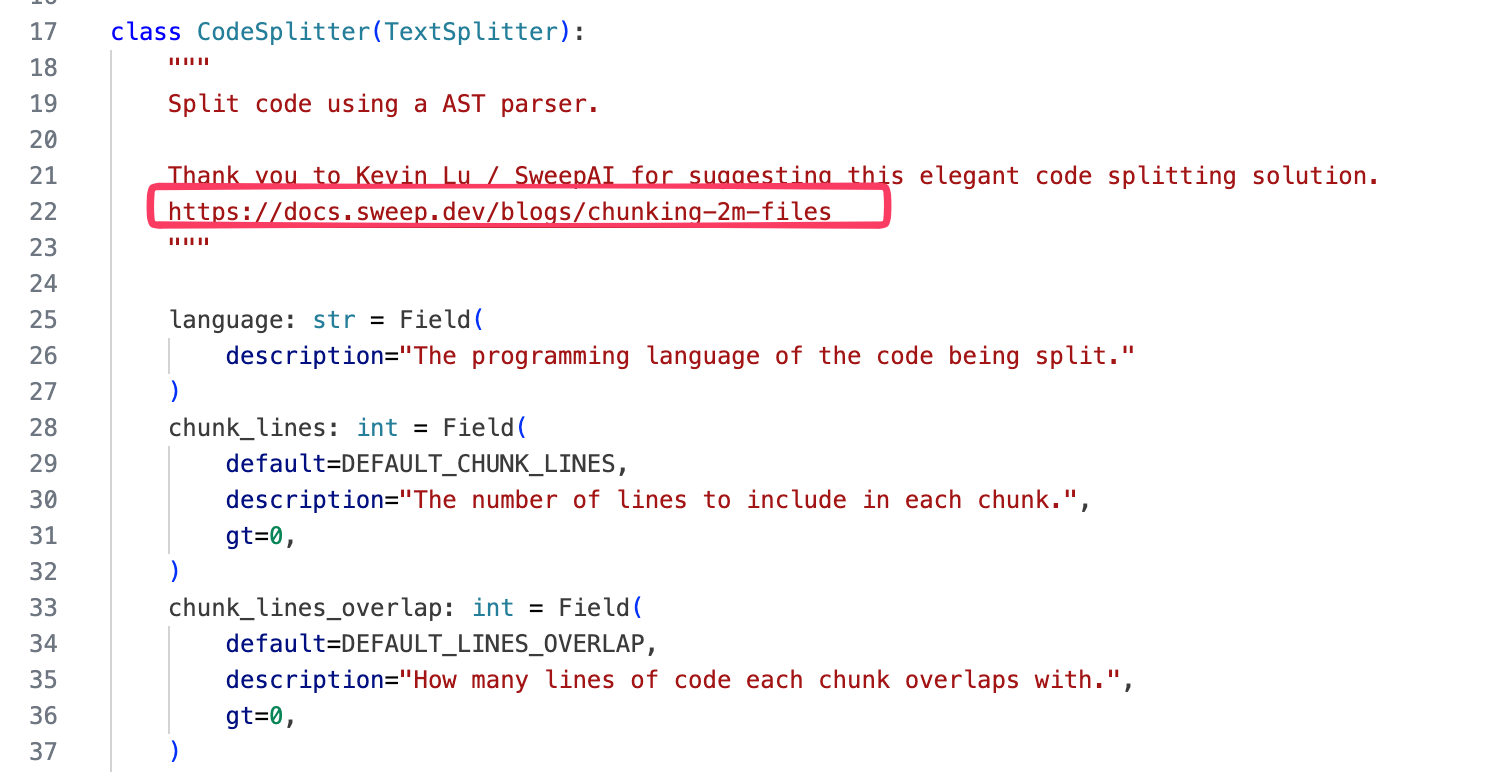
最近在研究 Code Splitter 的算法,发现 llama_index 的代码分割使用的是 sweepai 的代码分割算法,同时还提供了一篇博客,也就有了这篇文章。

初始化任何向量存储都需要对大型文档进行切分(chunking)以进行高效搜索。

为什么不能直接对整个文件做嵌入(embed)?以我们主 API 的 endpoint 文件 为例:

  1. 导入包
  2. 常量声明
  3. 辅助函数
  4. 每个 webhook endpoint 的业务逻辑

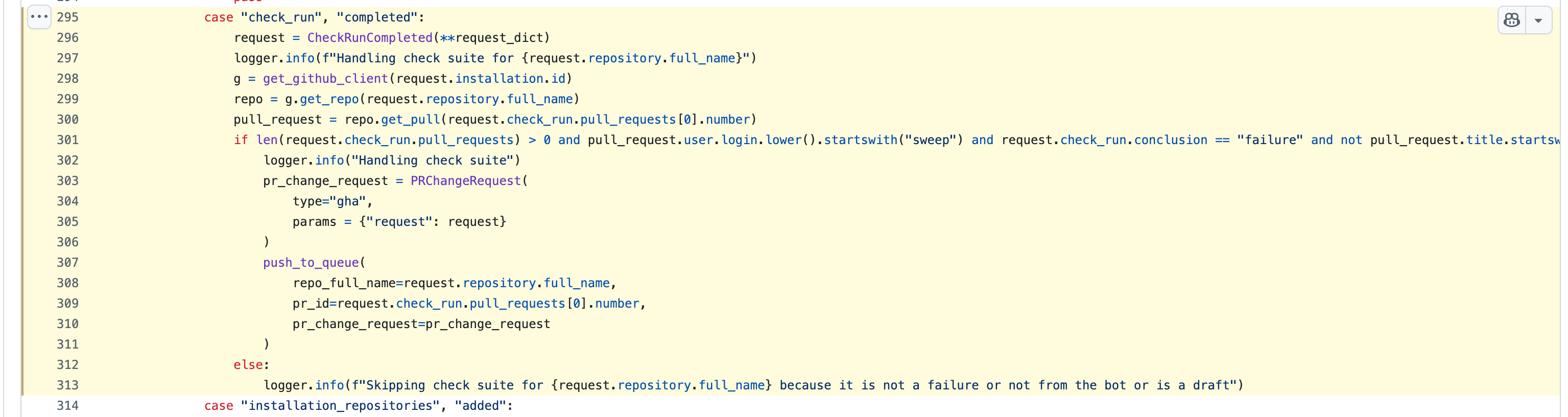
如果我搜索 “GitHub Action run”,它应该匹配检查 “check_runs completed” 事件的那个 switch case 块(参见 代码片段)。但那只是 400 多行代码中的大约 20 行,即使是完美的搜索算法也只会把相似性视为 5%。如果我们把 400 行切成 20 个每个 20 行的块,就更容易匹配到正确的 switch case 块。

那我们如何产生 20 行的块?一个简单的办法是均匀地把 400 行切成每 20 行一块。

但是,这种方法行不通。语义上相关的代码不会被保留在一起,且会丢失上下文。例如,函数头可能会被和实现体分离。

我们当前的代码切分算法每天处理 200 万+ 文件,并且已经开源了

约束 🚧

大多数用于 RAG(检索增强生成)的切分器按 token 数量做上限。为简化处理,我们决定使用字符数,上限设为 1500。

这是因为代码的平均 token 与字符比约为 1:5(300 tokens),而嵌入模型通常受 512 tokens 限制。进一步地,1500 字符大约对应 40 行,大致等同于一个小到中等大小的函数或类。

挑战在于尽可能接近 1500 字符,同时保证块在语义上保持一致且相关上下文被保留。

开箱即用的解决方案 📦

最简单的现成解决方案是 Langchain 的递归切分器(recursive chunker)。总体思路:

  1. 用顶层分隔符拆分文本(先用 class,然后是 function 定义,然后是方法等)
  2. 迭代每个区块并贪心地把它们串联直到超过字符限制。对于过大的区块,使用下一级分隔符递归切分。

示例伪代码:

1
2
3
4
5
6
7
8
9
10
11
12
13
14
15
16
17
18
19
delimiters = ["\nclass ", "\ndef ", "\n\tdef ", "\n\n", "\n", " ", ""]
def chunk(text: str, delimiter_index: int = 0, MAX_CHARS: int = 1500) -> list[str]:
delimiter = delimiters[delimiter_index]
new_chunks = []
current_chunk = ""
for section in text.split(delimiter):
if len(section) > MAX_CHARS:
# Section is too big, recursively chunk this section
new_chunks.append(current_chunk)
current_chunk = ""
new_chunks.extend(chunk(section, delimiter_index + 1, MAX_CHARS)
elif len(current_chunk) + len(section) > MAX_CHARS:
# Current chunk is max size
new_chunks.append(current_chunk)
current_chunk = section
else:
# Concatenate section to current_chunk
current_chunk += section
return new_chunks

针对每种语言我们会使用不同的分隔符。

示例

完整示例文件请见:https://gist.github.com/kevinlu1248/ded3ea33dcd8a9bd08078f4c64eb9268

示例 #1

基于我们处理 GitHub Action 运行的 on_check_suite.py 文件。一个糟糕的切分把字符串拼接声明与其内容分开了。❌

1
2
3
4
5
6
7
8
9
10
11
12
13
14
15
16
17
18
19
20
21
22
23
24
25
26
27
28
29
30
31
32
33
34
35
36
37
38
39
40
41
42
43
44
45
46
47
48
49
50
51
52
53
54
55
...

def on_check_suite(request: CheckRunCompleted):
logger.info(f"Received check run completed event for {request.repository.full_name}")
g = get_github_client(request.installation.id)
repo = g.get_repo(request.repository.full_name)
if not get_gha_enabled(repo):
logger.info(f"Skipping github action for {request.repository.full_name} because it is not enabled")
return None
pr = repo.get_pull(request.check_run.pull_requests[0].number)
num_pr_commits = len(list(pr.get_commits()))
if num_pr_commits > 20:
logger.info(f"Skipping github action for PR with {num_pr_commits} commits")
return None
logger.info(f"Running github action for PR with {num_pr_commits} commits")
logs = download_logs(
request.repository.full_name,
request.check_run.run_id,
request.installation.id
)
if not logs:
return None
logs = clean_logs(logs)
extractor = GHAExtractor()
logger.info(f"Extracting logs from {request.repository.full_name}, logs: {logs}")
problematic_logs = extractor.gha_extract(logs)
if problematic_logs.count("
") > 15:
problematic_logs += "

========================================

There are a lot of errors. This is likely a larger issue with the PR and not a small linting/type-checking issue."
comments = list(pr.get_issue_comments())
if len(comments) >= 2 and problematic_logs == comments[-1].body and comments[-2].body == comments[-1].body:
comment = pr.as_issue().create_comment(log_message.format(error_logs=problematic_logs) + "

I'm getting the same errors 3 times in a row, so I will stop working on fixing this PR.")
logger.warning("Skipping logs because it is duplicated")
raise Exception("Duplicate error logs")
print(problematic_logs)
comment = pr.as_issue().create_comment(log_message.format(error_logs=problematic_logs))
on_comment(
repo_full_name=request.repository.full_name,
repo_description=request.repository.description,
comment=problematic_logs,
pr_path=None,
pr_line_position=None,
username=request.sender.login,
installation_id=request.installation.id,
pr_number=request.check_run.pull_requests[0].number,
comment_id=comment.id,
repo=repo,
)
return {"success": True}

示例 #2

基于 LlamaIndex 的 BaseIndex.ts 文件(声明向量存储的 ABC)。糟糕的切分把类的方法实现与其头部分离了。❌

1
2
3
4
5
6
7
8
9
10
11
12
13
14
15
16
17
18
19
20
21
22
23
24
25
26
27
28
29
30
31
...

export class IndexDict extends IndexStruct {
nodesDict: Record<string, BaseNode> = {};
docStore: Record<string, Document> = {}; // FIXME: this should be implemented in storageContext
type: IndexStructType = IndexStructType.SIMPLE_DICT;

========================================

getSummary(): string {
if (this.summary === undefined) {
throw new Error("summary field of the index dict is not set");
}
return this.summary;
}

addNode(node: BaseNode, textId?: string) {
const vectorId = textId ?? node.id_;
this.nodesDict[vectorId] = node;
}

toJson(): Record<string, unknown> {
return {
...super.toJson(),
nodesDict: this.nodesDict,
type: this.type,
};
}
}

...

问题 🤔

然而,这个切分器存在严重问题:

  1. 对 Python 效果不错,但对大括号密集的语言(如 JS)和基于 XML 的语言(如 HTML)会在不可预期的地方断开。
    • 此外,str.split 对这些更复杂的语法(如 JS、HTML)效果不好。
    • 例如,即使对 Python,也会把像 problematic_logs += \" 与其余字符串错误地分割。
  2. 目前仅支持 16 种语言,不支持 JSX、Typescript、EJS 和 C#。
    • JSX/TSX 占我们用户群的大部分。
  3. Langchain 会删除重要分隔符(比如 “def” 和 “class”)。

我们的解决方案 🧠

根本问题是用一系列的 str.split 和分隔符来近似所谓的“具体语法树(CST)”是太原始了。

为了解决这个问题,我们直接使用 CST 解析器。如何获得大量语言的 CST 解析器?幸运的是,库 tree-sitter 提供了标准化访问 113 种编程语言 CST 解析器的方式,并且速度快(用 C 写)且无额外依赖。

新的算法在高层上与 Langchain 类似,步骤如下:

  1. 要对一个父节点进行切分,我们遍历其子节点并贪心地把它们打包在一起。对于每个子节点:
  2. 如果当前 chunk 太大,将其加入结果列表并清空当前 bundle
  3. 如果下一个子节点本身太大,则递归切分该子节点并把结果加入列表
  4. 否则,将该子节点的文本拼接到当前 chunk
  5. 对最终结果做后处理:把单行的 chunk 与下一个 chunk 合并
  6. 这样保证不会出现过小(意义不大)的 chunk

示例伪代码:

1
2
3
4
5
6
7
8
9
10
11
12
13
14
15
16
from tree_sitter import Node

def chunk_node(node: Node, text: str, MAX_CHARS: int = 1500) -> list[str]:
new_chunks = []
current_chunk = ""
for child in node.children:
if child.end_byte - child.start_byte > MAX_CHARS:
new_chunks.append(current_chunk)
current_chunk = ""
new_chunks.extend(chunk_node(child, text, MAX_CHARS)
elif len(current_chunk) + child.end_byte - child.start_byte > MAX_CHARS:
new_chunks.append(current_chunk)
current_chunk = text[node.start_byte:node.end_byte]
else:
current_chunk += text[node.start_byte:node.end_byte]
return new_chunks

示例

完整切分结果请见:https://gist.github.com/kevinlu1248/49a72a1978868775109c5627677dc512

示例 #1

基于我们的 on_check_suite.py 文件。正确的切分;在 if 语句之前做切分,而不是把 if 语句与其主体分开。✅

1
2
3
4
5
6
7
8
9
10
11
12
13
14
15
16
17
18
19
20
21
22
23
24
25
26
27
28
29
30
31
32
33
34
35
36
37
38
39
40
41
42
43
44
45
46
47
48
49
50
...

def on_check_suite(request: CheckRunCompleted):
logger.info(f"Received check run completed event for {request.repository.full_name}")
g = get_github_client(request.installation.id)
repo = g.get_repo(request.repository.full_name)
if not get_gha_enabled(repo):
logger.info(f"Skipping github action for {request.repository.full_name} because it is not enabled")
return None
pr = repo.get_pull(request.check_run.pull_requests[0].number)
num_pr_commits = len(list(pr.get_commits()))
if num_pr_commits > 20:
logger.info(f"Skipping github action for PR with {num_pr_commits} commits")
return None
logger.info(f"Running github action for PR with {num_pr_commits} commits")
logs = download_logs(
request.repository.full_name,
request.check_run.run_id,
request.installation.id
)
if not logs:
return None
logs = clean_logs(logs)
extractor = GHAExtractor()
logger.info(f"Extracting logs from {request.repository.full_name}, logs: {logs}")
problematic_logs = extractor.gha_extract(logs)
if problematic_logs.count("\n") > 15:
problematic_logs += "\n\nThere are a lot of errors. This is likely a larger issue with the PR and not a small linting/type-checking issue."
comments = list(pr.get_issue_comments())

==========

if len(comments) >= 2 and problematic_logs == comments[-1].body and comments[-2].body == comments[-1].body:
comment = pr.as_issue().create_comment(log_message.format(error_logs=problematic_logs) + "\n\nI'm getting the same errors 3 times in a row, so I will stop working on fixing this PR.")
logger.warning("Skipping logs because it is duplicated")
raise Exception("Duplicate error logs")
print(problematic_logs)
comment = pr.as_issue().create_comment(log_message.format(error_logs=problematic_logs))
on_comment(
repo_full_name=request.repository.full_name,
repo_description=request.repository.description,
comment=problematic_logs,
pr_path=None,
pr_line_position=None,
username=request.sender.login,
installation_id=request.installation.id,
pr_number=request.check_run.pull_requests[0].number,
comment_id=comment.id,
repo=repo,
)

示例 #2

基于 LlamaIndex 的 BaseIndex.ts 文件。我们的切分器正确地在导出的类和函数之间切分。✅

1
2
3
4
5
6
7
8
9
10
11
12
13
14
15
16
17
18
19
20
21
22
23
24
25
26
27
28
29
30
31
32
33
34
35
36
37
38
39
40
41
42
43
44
45
...

export class IndexDict extends IndexStruct {
nodesDict: Record<string, BaseNode> = {};
docStore: Record<string, Document> = {}; // FIXME: this should be implemented in storageContext
type: IndexStructType = IndexStructType.SIMPLE_DICT;

getSummary(): string {
if (this.summary === undefined) {
throw new Error("summary field of the index dict is not set");
}
return this.summary;
}

addNode(node: BaseNode, textId?: string) {
const vectorId = textId ?? node.id_;
this.nodesDict[vectorId] = node;
}

toJson(): Record<string, unknown> {
return {
...super.toJson(),
nodesDict: this.nodesDict,
type: this.type,
};
}
}

========================================

export function jsonToIndexStruct(json: any): IndexStruct {
if (json.type === IndexStructType.LIST) {
const indexList = new IndexList(json.indexId, json.summary);
indexList.nodes = json.nodes;
return indexList;
} else if (json.type === IndexStructType.SIMPLE_DICT) {
const indexDict = new IndexDict(json.indexId, json.summary);
indexDict.nodesDict = json.nodesDict;
return indexDict;
} else {
throw new Error(`Unknown index struct type: ${json.type}`);
}
}

...

算法其余部分 🤖

  1. 依次遍历支持的语言列表,直到某个解析器成功解析代码
  2. 对解析出的语法树根节点进行切分
  3. 如果没有任何语言成功解析,则使用一个普通的切分器:每次取 40 行,并在块间保留 15 行重叠(覆盖),这种情况约占 0.1%

示例伪代码:

1
2
3
4
5
6
7
8
9
10
11
12
13
14
15
16
17
18
19
20
21
22
23
24
25
26
27
28
29
30
31
32
33
34
35
36
37
38
language_names = ["python", "java", "cpp", "go", "rust", "ruby", "php"] # and more

# Installing the parsers
languages = {}
for language in LANGUAGE_NAMES:
subprocess.run(f"git clone https://github.com/tree-sitter/tree-sitter-{language} cache/tree-sitter-{language}", shell=True)
for language in LANGUAGE_NAMES:
Language.build_library(f'cache/build/{language}.so', [f"cache/tree-sitter-{language}"])
self.languages = {language: Language(f"cache/build/{language}.so", language) for language in LANGUAGE_NAMES}

def chunk(text: str, MAX_CHARS: int = 1500) -> list[str]:
# Determining the language
for language_name in language_names:
language = languages[language_name]
parser = Parser()
parser.set_language(language)
tree = parser.parse(bytes(text, "utf-8"))
if not tree.root_node.children or tree.root_node.children[0].type != "ERROR":
file_language = language
break
logger.warning(f"Not language {language_name}")

# Smart chunker
if file_language:
return chunk_node(tree.root_node, text, max_chunk_size)

# Naive algorithm
source_lines = file_content.split('\n')
num_lines = len(source_lines)
logger.info(f"Number of lines: {num_lines}")
chunks = []
start_line = 0
while start_line < num_lines and num_lines > overlap:
end_line = min(start_line + chunk_size, num_lines)
chunk = '\n'.join(source_lines[start_line:end_line])
chunks.append(chunk)
start_line += chunk_size - overlap
return chunks

在 Sweep,我们目前安装了 Python、Java、C++、Go、Rust、Ruby、PHP、C#、嵌入式模板(ERB & EJS)、Markdown、Vue 和 TSX。另请注意:C++ 覆盖 C,TSX 覆盖 JS、JSX 和 TS。

陷阱 🕳️

不幸的是,tree-sitter 有时并不可靠,很多解析器由社区维护:

  • TSX 解析器在无法解析时会挂起而不是返回错误
  • 此外,tree-sitter 的核心用 C 写成。在我们的 serverless 生产环境中运行需要一套复杂的方法来缓存已编译的 C 二进制,移动到可执行目录,并使用 Python 包装器去调用它们
  • 有些解析器在子节点之间留下空隙。我们通过合并(coalescing)解决了这个问题
  • 没有一种解析器会在解析错误的语言时都以相同方式报错
  • 有些解析器将根节点标记为 “ERROR”,而有些则把第一个 child 标为 ERROR

我们通过在遇到这些错误(例如 TSX 挂起或其他不可靠行为)时回退到朴素切分器来规避问题,并将 TSX 优先级放在最后。同时我们会优先尝试与文件扩展名相对应的语言解析器。

未来 🔮

这个算法现在已通过 https://github.com/jerryjliu/llama_index/pull/7100 集成到 LlamaIndex 中。

另一个问题是,文件中相距较远的代码片段可能仍然需要共享上下文。例如,一个类的方法可能需要类头的上下文,长函数也需要函数签名。一个可能的改进是采用类似以下的格式来保留上下文:

1
2
3
4
class Foo:
...
def bar(self):
pass

我们可以考虑使用 universal ctags 或类似工具以实现更简单、更通用的解析,或者在手工标注的切分上训练一个自定义的 spaCy sentencizer,但那可能有点过度设计。


AI 如何用 AST 每天对 200 万+ 文件做高质量分块(用于代码搜索)
http://crossoverjie.top/2025/12/29/AI/chunking-2m-files/
Author
crossoverJie
Posted on
December 29, 2025
Licensed under